

Life before September 11th was much different in several ways and the effects of 9/11 impacts us still today.
Okay, as many of the parents of today’s teenagers will be able to recall, getting on an airplane before 9/11 was simpler in all regards: it cost less, and when you got to the airport, you basically just got on a plane and left. To those born after 9/11, this magical world may seem like a distant fairytale. But ask any gray-haired adult, and they will be able to confirm it existed!
September 11th Still Impacts Everyday Life Today
When history happens, its easy to thing of it as a past tense event. But the reality is that very often those events and the policies and laws that happen are things to affect us long after they disappear from the evening news.
I: You Could Get on an Airport Without Disrobing
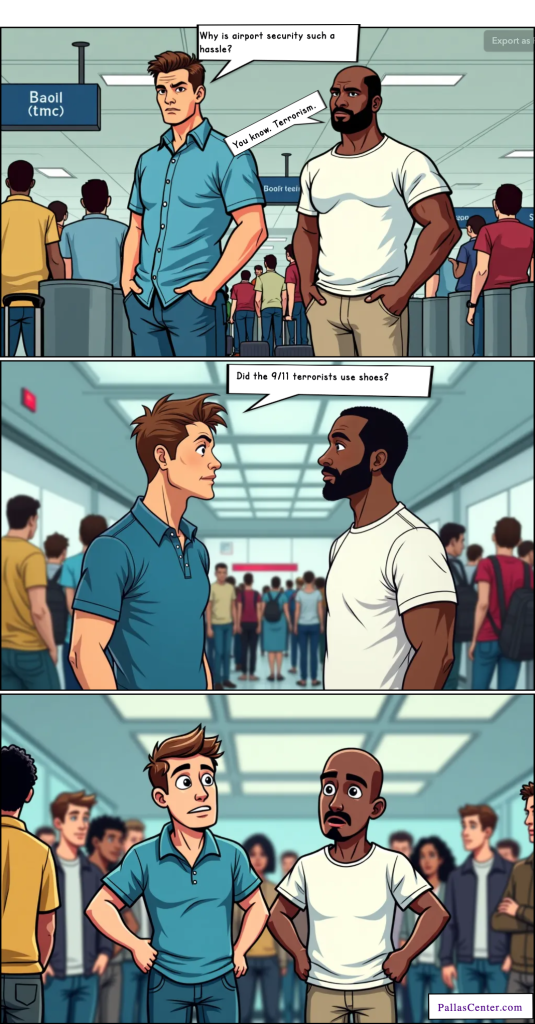
Before September 11th, flying across the country or even around the world was MUCH simpler. After 9/11, simple security measures were a thing of the past…quickly upgraded. Simple metal detectors were amended to include body scans, pat downs, removing your shoes, bag searches, profiling and long lines.
Now, certainly a case can be made that the security measures implemented after 9/11 benefited us, and prevented other large-scale terrorist attacks. But the next time you are at an airport and engaged in various forms of required disrobing, it may be worth remembering the history of 9/11, and understanding how we got here — and to what extent we should still be here.
II. Domestic Protests
While missing a flight because it took two hours to get through security since everyone had to take their shoes off can have serious consequences, a bigger impact of 9/11 is likely the emergence of the National Counterterrorism Center (NCTC). As discussed in our 9/11 course, 9/11 resulted in a massive restructuring of the US intelligence structure, ostensibly to facilitate sharing of intelligence and enable faster responses to domestic threats. A by-product of this initiative was the creation of the NCTC.
In today’s world, the NCTC is credited with stopping many acts of terror. However, it is also surveilling campus protestors, looking for connections between protestors and terrorist financing. Some would argue these connections are real and vital to identify and squash; others argue this is an attempt to quell dissent, and curtail free speech. Whatever conclusion you come to, having an education of the history of 9/11 will help you immensely.
III. Surveillance State
Along with the NCTC, the restructuring of the intelligence community involved the creation of fusion centers — basically centralized points where intelligence was gathered. In addition to allowing intelligence from a variety of sources to be more easily assimilated to fight terrorism, it also set the stage for private companies to access data via fusion centers for their own purposes.
Palantir, for instance, is a private government contractor that made software allowing law enforcement to use data from fusion centers to quickly gather comprehensive data on individuals with just a few inputs (i.e. a license plate ID, or a photo). This has led to some concerns over erosion of civil liberties and individuals’ right to privacy.

Understanding the how and why these policies came about can help us understand if these policies are worthwhile — or if we would benefit from changing them. From this perspective, the history of 9/11 remains essential studying.


More Reading:
