
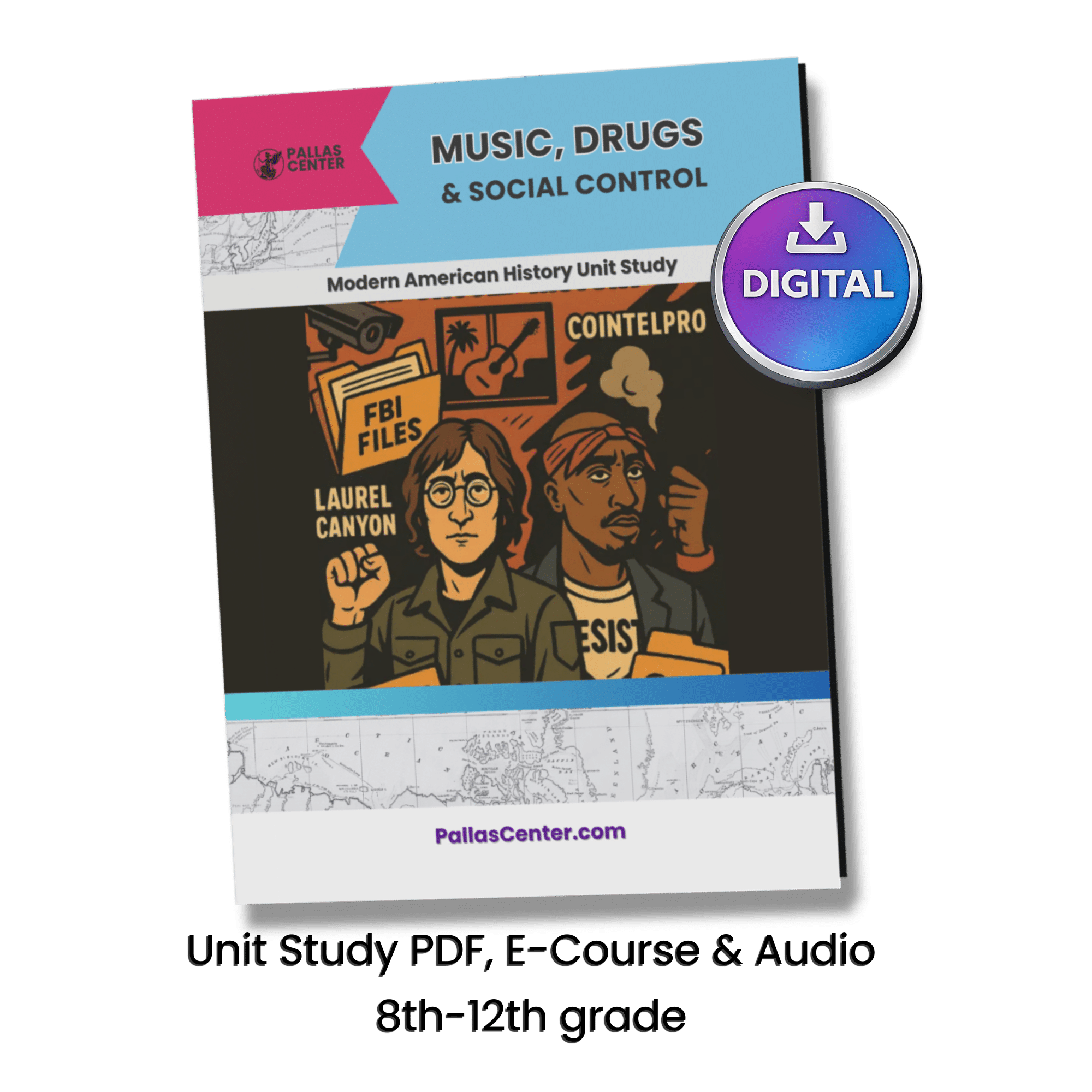
Uncover the Hidden History of Music, Drugs, and Power
Music has always been more than entertainment—it’s been a force for change, a threat to authority, and sometimes, a tool of control. From the counterculture movements of the 1960s to today’s music industry, the relationship between musicians, governments, and powerful institutions reveals a story few textbooks tell.
In this 8-module course, students will dive deep into the controversial and eye-opening intersections of music, drugs, and social control. They will learn how politically conscious artists used their platforms to challenge injustice—and how institutions of power responded through surveillance, manipulation, and sometimes even violence.
Designed for middle and high school students, this course assumes no prior knowledge and will challenge students to think critically, analyze primary sources, and question official narratives while building the skills of independent, investigative learners.
Unit Study Table of Contents
-
MKULTRA was a Mind and Social Control Initiative
-
The CIA Distributed Drugs as a Strategy to Control the Population
-
Music Was Fueling Anti-War Resistance in the 1960s, and Thus Became a Target
-
The US Government Put Popular Anti-War Musicians Under Surveillance
-
Many Popular Musicians From the 1960s Had Links to Military Intelligence
-
Activist Musicians Like John Lennon Were Assassinated
-
Tupac Shakur Was Targeted for Elimination
-
The State of Music and Drugs in Today’s World as a Form of Social Control
What’s Included (3 options)
E-Course with Podcast Option
-
8 detailed, source-linked readings
-
Built-in podcast audio for each lesson
-
Comprehension quiz
-
Discussion prompts for classroom or family dialogue
-
Assignments to deepen learning
- Glossary of Terms
E-Book Unit Study (Printable PDF)
-
Downloadable and printable PDF
-
8 detailed readings
-
Discussion prompts for classroom or family dialogue
-
Assignments to deepen learning
- Glossary of Terms
Why This Course Matters
The story of music and drugs in modern history is also the story of democracy, free expression, and the lengths to which power will go to preserve control. By studying declassified documents, cultural history, and the personal stories of musicians like John Lennon and Tupac Shakur, students will uncover how art, politics, and social movements collide.
This course isn’t about fostering cynicism—it’s about cultivating the informed skepticism necessary for responsible citizenship. By understanding how dissent has been suppressed in the past, students will be better equipped to recognize and protect the freedoms that define democratic societies today.
Benefits of Enrolling
Perspective: Understand the hidden connections between music, drug culture, and government influence.
Critical Thinking: Learn to distinguish between conspiracy theory and documented historical fact.
Relevance: Connect lessons from the past to today’s struggles over freedom, culture, and control.
Preparation for College: Build valuable skills in research, analysis, and discussion that will serve students in higher education and beyond.

Reviews
There are no reviews yet.