Birth of the Global Era: Multiculturalism and the Coming Apart
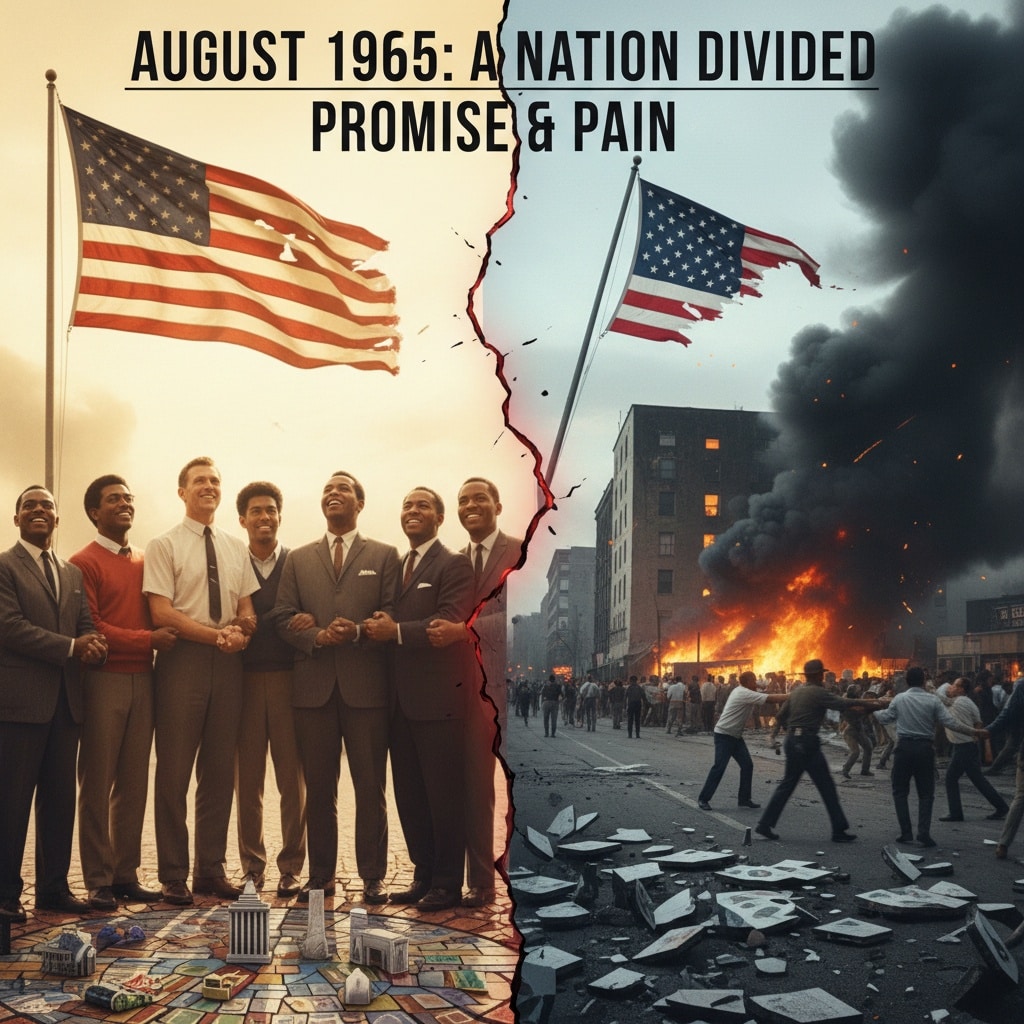
As we learned in our previous lesson about the civil rights movement, the passage of the Voting Rights Act on August 6, 1965, represented the culmination of decades of struggle for racial equality in America. However, just five days later, an event would occur that would fundamentally transform American society and mark the end of what historians call the “National Era” and the beginning of something entirely new—the “Global Era.” This transformation would reshape how Americans understood themselves, their country, and their place in the world for the next half-century.
The Hinge of History: August 1965
The Watts riot began on August 11, 1965, just five days after the Voting Rights Act became law. As historian Nicholas Lemann observed, “the 1960s turned as if on a hinge” during the summer of 1965. This massive ghetto riot “instantly convinced the whole country that there was a severe crisis in the black slums.” What had begun as a civil rights movement using Gandhian language and tactics of nonviolence suddenly transformed into something quite different—a movement expressing anger and demanding both governmental and symbolic benefits.
This moment marked more than just urban unrest; it represented the end of America’s National Era, which had maintained “a national consensus in support of broad social unity from the country’s origins through the early 1960s, except for the Civil War period.” The focus of American identity was about to shift dramatically “from the nation to the group.”
The Rise of Multiculturalism
A Fundamental Shift in Identity
During the late 1960s and early 1970s, large numbers of Americans experienced what can only be described as a revolutionary change in how they saw themselves. The breadth of Americans’ identification narrowed as attachment was redirected from the nation to racial, ethnic, gender, and lifestyle groups. This didn’t happen to everyone, but it occurred in enough people that it “firmed into a tacit consensus.”
This shift brought with it a profound change in perspective. Increased concern with one’s specific group went hand-in-hand with heightened sensitivity toward how society treated that group and diminished concern with how the group treated society. The United States was among the earliest countries to make this transition, but the pattern would eventually spread throughout the Western world.
The Rejection of Traditional Unity
Multiculturalism represented a fundamental departure from the classical and Christian universalism that had dominated Western thought since antiquity. The old “melting pot” ideal—where immigrants and diverse groups gradually blended into a common American identity—was now rejected by American elites as an instrument of “nativist bigots.”
Under the previous National Era, the United States had maintained a consensus “presided over by the WASPs (White, Anglo-Saxon Protestants), the upper-, upper-middle-, and middle-class versions of whose culture were the esteemed norms.” While this system had its exclusions and problems, it provided a common framework that many different groups—Catholics, Jews, blacks, Hispanics, and Asians—had “accepted that consensus, paid respect to it, aspired to blend into it, and raised their children to do the same.”
Multiculturalism shattered this framework, breaking society into what scholars describe as “factious, alienated groups.” Nearly all of the domestic conflicts that would plague the United States throughout the Global Era were ultimately about whether American society and civilization were to be reorganized on the basis of what critics called “resentful splintering.”
The Transformation of the Civil Rights Movement
The change from civil rights to Black Power exemplifies the broader shift toward multiculturalism. The civil rights movement had originally employed Gandhian tactics of nonviolence and appealed to universal principles of human dignity and equality. African Americans sought to reject their second-class status and gain the same legal rights enjoyed by other Americans.
However, with the Watts riot and subsequent urban uprisings, the movement “abruptly metamorphosed into a movement of black power that expressed disaffection and pursued tangible and intangible benefits.” This represented more than a tactical shift; it reflected the new multicultural paradigm that emphasized group identity and grievances rather than universal principles and national unity.
The Global Context
America as a Microcosm of World Conflict
As multiculturalism took hold in America, similar patterns emerged worldwide. The opening of national borders and the free flow of people, products, ideas, and images created unprecedented cultural mixing. For the first time in world history, there was “maximum encounter with sociocultural difference.”
This mixing brought both opportunities and challenges. As one observer noted, “America is becoming a microcosm of a world on fire.” The traditional geographic separation that had once insulated different peoples and cultures from each other disappeared. “First- and third-world peoples, Christians and Muslims, seculars and believers, hipsters and traditionalists had once been insulated from each other but were now cheek by jowl.”
The Celebration of Diversity
The burgeoning real and virtual megalopolises of global-liberal societies didn’t just mingle the peoples of the world—they actively celebrated diversity in what scholars termed a “chaotic-exotic” style. This celebration of difference became a defining feature of the new era, marking a sharp departure from previous expectations that diverse groups would gradually assimilate into a common culture.
The Consequences of Fragmentation
Political and Social Division
The adoption of multiculturalism carried a steep price for American society. The doctrine’s “accusations of grievous collective injustice against the country, its founding fathers, and its entire national heritage initiated a reverberating series of negative consequences.” These accusations created a fundamental split between those who maintained traditional attachments to American institutions and history and those who viewed these same institutions as fundamentally tainted by injustice.
Multiculturalism “represented the fundamental coming apart that drove the multiple other comings apart” that would characterize the Global Era. As the country fractured along group lines, it became increasingly difficult to maintain the social cohesion necessary for effective democratic governance.
The Spread of Disintegration
The pattern that began in the United States eventually spread to Europe “after a 25-year lag.” Like America, European nations found themselves grappling with questions of identity, immigration, and social cohesion. The same generational changes that had transformed America—as the World War II generation receded—also affected European leadership. Leaders like Willy Brandt and Helmut Schmidt had possessed “the toughness, realism, and balance with which to refuse entry to those difficult to integrate,” but their successors like Gerhard Schroeder and Angela Merkel could not maintain such standards.
A World Coming Apart
By the end of the Global Era, the pattern of fragmentation had become global. As one commentator observed: “Tribes and nations are splitting apart. Libya, Syria and Iraq are coming apart, as did Sudan and Ethiopia. The Kurds seek to carve a nation out of Turkey, Iran, Iraq and Syria. A Sunni-Shia sectarian war impends. Christians are being persecuted, martyred and expelled from Islamic nations.”
The End of an Era
America’s Vulnerability
After 51 years under the global-liberal paradigm, the United States found itself “divided, weakened, poorly governed, and internationally vulnerable.” The country’s national security was being challenged on multiple fronts, most ominously by China. As former Secretary of State Henry Kissinger assessed the circumstances at the end of the Global Era, they were “very, very grave.”
The fundamental problem was that multiculturalism had broken American society into competing factions that could no longer agree on basic questions of national identity, historical memory, or shared values. This fragmentation made it increasingly difficult for the country to function effectively either domestically or internationally.
The Limits of Multicultural Appeal
Despite decades of institutional support, multiculturalism began to show its political limitations by the end of the Global Era. The ideology had “a very high idealistic notion of justice that is somehow disconnected from American realities.” This disconnection became apparent when working-class Black and Latino Americans “do not share all the values of progressive Americans” and some even “might switch their vote to Trump.”
The facts of American society—increasing intermarriage, growing cultural mixing, and the development of more fluid identities—contradicted the rigid group-based thinking of multiculturalism. As one scholar noted, “we’re becoming a far more interracial, intermarried, mixed society in the last 20 years than we ever were before, just stunningly changed.”
Key Takeaways
The period from 1965 to 2016 witnessed a fundamental transformation of American society through the adoption of multiculturalism as the dominant paradigm for understanding identity and social relations.
The Watts riot of August 11, 1965, marked the end of America’s National Era and the beginning of the Global Era, shifting focus from national unity to group identity.
Multiculturalism replaced the traditional “melting pot” ideal with a celebration of difference and group-based grievances, breaking American society into competing factions.
This fragmentation spread from the United States to Europe and other Western nations, creating similar patterns of social division and political conflict.
By 2016, multiculturalism’s limitations became apparent as it failed to reflect the increasingly mixed and fluid nature of American society, setting the stage for a new political paradigm.
The consequences of this 51-year experiment in multiculturalism left America “divided, weakened, poorly governed, and internationally vulnerable,” creating the conditions that would lead to the rise of new political movements and the emergence of what would become known as the “Gamers”—America’s new upper class—which we will explore in our next lesson.
